Tuesday, December 8, 2009

Book of the month for December

Violence, in McCarthy's postapocalyptic tour de force, has been visited worldwide in the form of a "long shear of light and then a series of low concussions" that leaves cities and forests burned, birds and fish dead and the earth shrouded in gray clouds of ash. In this landscape, an unnamed man and his young son journey down a road to get to the sea. (The man's wife, who gave birth to the boy after calamity struck, has killed herself.) They carry blankets and scavenged food in a shopping cart, and the man is armed with a revolver loaded with his last two bullets. Beyond the ever-present possibility of starvation lies the threat of roving bands of cannibalistic thugs. The man assures the boy that the two of them are "good guys," but from the way his father treats other stray survivors the boy sees that his father has turned into an amoral survivalist, tenuously attached to the morality of the past by his fierce love for his son. McCarthy establishes himself here as the closest thing in American literature to an Old Testament prophet, trolling the blackest registers of human emotion to create a haunting and grim novel about civilization's slow death after the power goes out.
~Publishers Weekly

GET THIS BOOK FROM THE HCT CATALOGUE

Wednesday, June 3, 2009

Book of the month for June


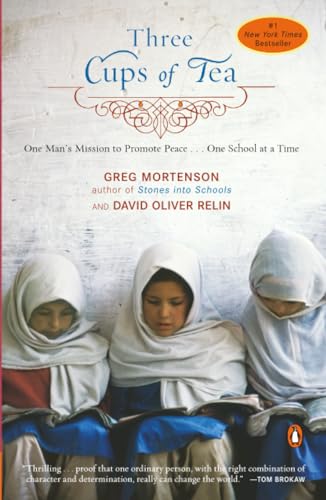
Some failures lead to phenomenal successes, and this American nurse's unsuccessful attempt to climb K2, the world's second tallest mountain, is one of them. Dangerously ill when he finished his climb in 1993, Mortenson was sheltered for seven weeks by the small Pakistani village of Korphe; in return, he promised to build the impoverished town's first school, a project that grew into the Central Asia Institute, which has since constructed more than 50 schools across rural Pakistan and Afghanistan. Coauthor Relin recounts Mortenson's efforts in fascinating detail, presenting compelling portraits of the village elders, con artists, philanthropists, mujahideen, Taliban officials, ambitious school girls and upright Muslims Mortenson met along the way. As the book moves into the post-9/11 world, Mortenson and Relin argue that the United States must fight Islamic extremism in the region through collaborative efforts to alleviate poverty and improve access to education, especially for girls. Captivating and suspenseful, with engrossing accounts of both hostilities and unlikely friendships, this book will win many readers' hearts.

~Publishers Weekly


Sunday, May 3, 2009

Book of the month for May

Adult/High School-A novel about assimilation and generational differences. Gogol is so named because his father believes that sitting up in a sleeping car reading Nikolai Gogol's "The Overcoat" saved him when the train he was on derailed and most passengers perished. After his arranged marriage, the man and his wife leave India for America, where he eventually becomes a professor. They adopt American ways, yet all of their friends are Bengalis. But for young Gogol and his sister, Boston is home, and trips to Calcutta to visit relatives are voyages to a foreign land. He finds his strange name a constant irritant, and eventually he changes it to Nikhil. When he is a senior at Yale, his father finally tells him the story of his name. Moving to New York to work as an architect, he meets Maxine, his first real love, but they separate after his father dies. Later, his mother reintroduces him to a Bengali woman, and they fall in love and marry, but their union does not last. The tale comes full circle when the protagonist, home for a Bengali Christmas, rediscovers his father's gift of Gogol's short stories. This novel will attract not just teens of other cultures, but also readers struggling with the challenges of growing up and tugging at family ties.

~School Library Journal

Wednesday, April 1, 2009

Book of the month for April

The daughter of a wealthy government official, Najwa grows up pampered and carefree in western Sudan during the 1980s. With her 19th birthday, though, comes the overthrow of the president and arrest of her father by the new government. Najwa; her twin brother, Omar; and their mother flee to London. Within a few years, she is completely alone: her father has been executed, her mother succumbs to a fatal illness, and Omar is in prison for an assault conviction stemming from his drug abuse. Once a fashionable university student in Khartoum, the young woman makes ends meet as a nanny to a wealthy Arab family. Clothed in traditional Muslim hijab, she has suddenly become invisible within the city, much as the Ethiopian servants used to blend into the background in her parents household. Yet even as she comes to terms with this anonymity, a spark develops between her and the younger brother of her employer, and she is forced to confront the chasm between servant and master. Aboulela offers a captivating glimpse into one womans journey through the various strata of society. The protagonists experiences give her a deeper reliance on her faith and help her to recognize the shallowness of the life she left behind. This is the authors first work to be published in the U.S. Students will appreciate the story not only for its insights into Muslim faith and traditions, but also for the ways her compellingly real characters relate to one another.
~ School Library Journal

I like her adventure in this story and the way she feels about her faith and wearing hijab and reading Quran. - Khawla Al Shehhi Ras Al Khaimah Women's College

Sunday, March 1, 2009

Book of the month for March

British novelist Gaiman (American Gods; Stardust) and his long-time accomplice McKean (collaborators on a number of Gaiman's Sandman graphic novels as well as The Day I Swapped My Dad for 2 Goldfish) spin an electrifyingly creepy tale likely to haunt young readers for many moons. After Coraline and her parents move into an old house, Coraline asks her mother about a mysterious locked door. Her mother unlocks it to reveal that it leads nowhere: "When they turned the house into flats, they simply bricked it up," her mother explains. But something about the door attracts the girl, and when she later unlocks it herself, the bricks have disappeared. Through the door, she travels a dark corridor (which smells "like something very old and very slow") into a world that eerily mimics her own, but with sinister differences. "I'm your other mother," announces a woman who looks like Coraline's mother, except "her eyes were big black buttons." Coraline eventually makes it back to her real home only to find that her parents are missing--they're trapped in the shadowy other world, of course, and it's up to their scrappy daughter to save them. Gaiman twines his taut tale with a menacing tone and crisp prose fraught with memorable imagery ("Her other mother's hand scuttled off Coraline's shoulder like a frightened spider"), yet keeps the narrative just this side of terrifying. The imagery adds layers of psychological complexity (the button eyes of the characters in the other world vs. the heroine's increasing ability to distinguish between what is real and what is not; elements of Coraline's dreams that inform her waking decisions). McKean's scratchy, angular drawings, reminiscent of Victorian etchings, add an ominous edge that helps ensure this book will be a real bedtime-buster.

~Review by Publishers Weekly

Wednesday, February 4, 2009

Book of the month for February

Again, as in The Haunting (1982), New Zealand writer Mahy proves that all-out supernatural stories can still be written with intelligence, humor, and a fearful intensity that never descends into pretentious murk or lurid sensationalism. Laura, 14, living with divorced Mum (a bookstore manager) and little brother Jacko in a small New Zealand town, is a "sensitive." She gets "warnings" when big disturbances - like her parents' divorce - are imminent. She has the ability to take one look at older schoolmate Sorensen Carlisle and know that he's a witch. And when an old junk-store owner named Carmody Braque playfully stamps Jacko's hand with a smiling replica of Braque's own face, it's Laura who soon realizes that something ghastly has happened: "the stamp was part of him now, more than a tattoo - a sort of parasite picture tunneling its way deeper and deeper, feeding itself as it went." Jacko falls ill, then becomes seriously, mysteriously sick, wasting away, comatose, in a hospital bed. Laura's distraught mother, now growing closer to a librariansuitor, can't even listen to her daughter's ideas about the supernatural causes of Jacko's decline. So Laura desperately turns for help to "Sorry" Carlisle, who lives in a forbidding ancestral manse with his mother and grandmother - good witches who tried (in vain) to give Sorry a normal life away from magic. At first the Carlisles are cautious, distant, slow to admit their witchly powers; Sorry, deeply ambivalent about witch-hood, is sarcastic, sexually teasing. But eventually they agree to guide Laura in her battle for Jacko's life against Carmody Braque, a demon who must feed on human souls and bodies. The first step? Laura must make the "changeover" into witch-hood - something her psychic sensibility makes possible. (The visionary ritual involved is a perfect mix of the chilling and the comic, with Laura taking pot-shots at the poor literary quality of Sorry's chants.) Then, with moral support from Sorry, Laura must have a one-on-one confrontation with demon Braque, hiding her new witch-hood behind dark glasses and stamping his hand with a sign of her power. And finally, after Braque's Oz-style annihilation ("he continued to change back through the centuries of stolen life until his clothes collapsed around what at first appeared to be a rotting, heaving mass"), Laura can celebrate Jacko's recovery - and her own recovery from "a secret illness no one had ever completely recognized or been able to cure": the post-divorce hatred of her father, the jealousy of her mother's new boyfriend. Mahy thus invests the occult evils here with a metaphorical, psychological undertow; at the same time, however, while filling out all the characters (including the witches) with textured charm, she never stints on thoroughgoing creeps and scares. In sum: the best supernatural YA fiction around, with Stephen King power and Mahy's own class and polish.

~Review by Kirkus Reviews

Sunday, January 4, 2009

Book of the month for January

PITY the contemporary travel writer: routinely viewed as a kind of overstuffed guidebook author, struggling to explain exactly what he or she does. Specialists pounce on the tiniest "mistakes," and ideologues condemn the whole enterprise as colonialism with a thesaurus. Meanwhile, there's no single go-to word for what this most curious and searching of writers seeks to produce. Travel narrative? Peripatetic memoir? Adventure yarn? Not that this even matters, since — or so the prevailing wisdom goes — the best journeys have already been made. All that's left is a specious sort of experiential plagiarism.

Not quite. Rory Stewart's first book, "The Places in Between," recounts his journey across Afghanistan in January 2002. Even in mild weather in an Abrams tank, such a trip would be mane-whitening. But Stewart goes in the middle of winter, crossing through some territory still shakily held by the Taliban — and entirely on foot. There are some Medusa-slayingly gutsy travel writers out there — Redmond O'Hanlon, Jeffrey Tayler, Robert Young Pelton — but Stewart makes them look like Hilton sisters.

Paul Theroux once described a certain kind of travel book as having mainly "human sacrifice" allure, and how close Stewart comes to being killed on his journey won't be disclosed here. He is, however, sternly warned before he begins his walk. "You are the first tourist in Afghanistan," observes an Afghan from the country's recently resurrected Security Service. "It is mid-winter," he adds. "There are three meters of snow on the high passes, there are wolves, and this is a war. You will die, I can guarantee." For perhaps the first time in the history of travel writing, a secret-police goon emerges as the voice of sobriety and reason.

Recalling an American journalist who wondered if Stewart thought what he was doing was dangerous, he writes, "I had never found a way to answer that question without sounding awkward, insincere or ridiculous." He's then asked if he has read "Into the Wild," Jon Krakauer's account of a well-meaning young man's doomed trek into the Alaskan wilderness. It is, Stewart is told, more than a little pointedly, "a great piece of journalism."

So is "The Places in Between" — a pipsqueak title for what is otherwise a striding, glorious book. But it's more than great journalism. It's a great travel narrative. Learned but gentle, tough but humane, Stewart — a Scottish journalist who has served in both the British Army and the Foreign Office — seems hewn from 19th-century DNA, yet he's also blessed with a 21st-century motherboard. He writes with a mystic's appreciation of the natural world, a novelist's sense of character and a comedian's sense of timing.

Review by the New York Times read the full review here

GET THIS BOOK FROM THE HCT CATALOGUE